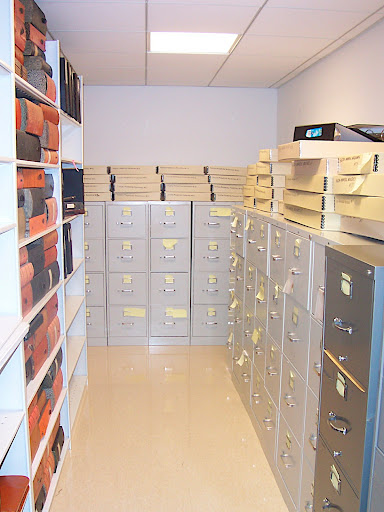
 Group Suida-Manning has now visited our collection at the Blanton Museum twice. During the first meeting, Blanton Registrar Sue Ellen Jeffers introduced us to the collection, which consists of personal and professional papers belonging to art historian and collector William Suida (1877-1959), his daughter Bertina (1922-1992), and her husband Robert Manning (1924-1996). Bertina and Robert Manning were art collectors who also served as curators for the Chrysler Collection and Samuel H. Kress Foundation respectively. The Suida- Manning Papers are currently located on the third floor of the Blanton's Educational/Administrative building and are housed in 13 metal, 4-drawer filing cabinets, 38 Flat Metal Edge Boxes, and 1 and 1/3 large bookshelves of letter boxes and other materials (see left). Since Liz has already posted a summary of our initial meeting notes (http://digitalizzie.blogspot.com/), including our more specific measurements of the size of the collection, I will not repeat that information here.
The challenges of this collection are its size, its mixed media (photographs, prints, glass lantern slides, manuscripts, printed materials, and a small number of artifacts), and its lack of organization. As Sue Ellen Jeffers noted, much of the material arrived at the Blanton appearing to have been thrown pêle mêle into boxes. Due to time and budget constraints, the staff at the Blanton have simply transferred the material to the aforementioned filing cabinets, flat boxes, and shelves. The items in the filing cabinets (predominantly art prints and manuscripts) are particularly in jeopardy because many of the drawers are overcrowded and, without housing such as folders, the material they contain is bent and unsupported.
During our second visit to the Blanton, Liz and I were joined by our new group members, Lauren and Beth. Together we set out to produce a brief and informal inventory of what was in each drawer and container. The purpose of this endeavor was to gain a better idea of the types and quantities of materials in the collection (both in terms of physical media and record types) as well as their physical location so that we might decide how best to proceed. In general, for each drawer, we attempted to record the number of the drawer, how full it was (expressed as a percentage); the types of media/materials contained therein (including relative percentages at the drawer-level where possible), the types of housing present (if any), and any additional initial observations (e.g. notes on mold, obvious damage, smells, as well as items of particular interest). In her original assessment, Sue Ellen Jeffers estimated that the collection was approximately 50% prints, 50% manuscripts. Our initial examination suggests that there is actually a somewhat higher percentage of prints.
Two important challenges/questions emerging from our research thus far are:
- How do we balance the Blanton's desire to know about where various document types (e.g. correspondence [personal and business], teaching notes, documents related to the Suida-Manning's art collecting, art historical research) are located with the general disorganization and intermixedness of the collection and our own course goal of providing a preservation assessment rather than archival inventory?
- If we conduct a "drawer-level" assessment of the entire population so as to address our most pressing concern--providing recommendations for appropriate housing that would include quantities of folders and other provisions to be purchased--, how should we structure a second smaller survey on a stratified sample aimed at accumulating specific detailed information on the current preservation condition of items from all of the various physical media types?


I am so glad that you enjoy the collection. It will provide you all with a wonderful experience!
ReplyDeleteI think it's really interesting that you are going to have to balance taking into consideration the needs and desires of the Blanton staff with the defined scope of the project, which is a preservation assessment not a cataloging endeavor. Do you anticipate being able to address the disorganization of the materials? Are you planning to leave all locations as they are or to regroup some materials into piles/segments that relate to each other according to some simple criteria?
ReplyDeleteDo you think that cataloging has to take place before rehousing, or is it more important to rehouse the items ASAP in order to better preserve them?